
Bea at Four
- Chris Maunder
- May 13
- 12 min read
Updated: May 15

My little daughter Beatrice is now four years old! In September, she will enter the reception class of a primary school. She is now at the age when she confidently declares her full name to be ‘Beatrice Violet Maunder’, and she can tentatively write her first name. Her writing and drawing have improved tremendously over the last few months; these things can suddenly come together in a developing child, just when you thought they were struggling. And her reading has always been promising, as she loves books. So Natalie and I think that she is ready to enter the hurly-burly of the school environment.
Don’t call her Bea or Beatrice when she is in role play mode, because dressing up is one of her favourite pastimes. Then she becomes Snow White, Rapunzel, or Princess Elsa, and she doesn’t take kindly to being called by her usual name! If we had to guess a future career, then actress wouldn’t be far-fetched; her memory for text is quite impressive. The slightest deviation from what is written down in a bedtime read and, although she can’t yet read all the words, she will remember from previous reads that you have been just a bit cavalier with the story as it is in the book (or, in my case, you can’t always see it too well in bedtime lighting). Added to that, if she sees anything that resembles a stage, she is transformed into a performer and insists on doing a little act, bowing, and then expecting you to throw flowers! Where does she get all this from?

The answer, of course, is television. Like most children of her age, she does love the telly. We do try and restrict the hours spent in front of the T.V. and also monitor the type of programme she watches. Programmes that invite the children into a gentle world of make-believe are the best, but there are many aimed at young children, on Youtube for example, that show things being played with, made, or painted (by doing so, they are advertising the products). While these appear to be innocent, even quite constructive, the evidence suggests that they put the children into a trance mode that results in bad behaviour, and we can testify to that. Youtube is definitely out or, at least, very restricted. The other programmes we do not encourage are the American or Asian kind with cartoons full of lurid colour, lots of fast action, and characters with very big, shiny eyes. Again, these can be entrancing and addictive.
Cartoons like Bluey or Peppa Pig seem OK, and they introduce young children to all kinds of normal dilemmas and situations which are helpful. All the characters are very realistic with their flaws and challenges. This can get quite disconcerting as the parents in the cartoons are shown up with all their faults – ditherers, boasters, or just targets for teasing. The ordeals that Bluey and her sister Bingo put their father through are quite alarming! Bea is getting some dangerous ideas. She has already referred to me as ‘Big Fella’, which is what the precocious Bluey calls her Dad. Yet, overall, cartoons like these are highly rated and teach children to be imaginative and adventurous in safe ways.

Julia Donaldson rather dominates the children’s book market in this country, and we can see why. Her books, many of which have been animated and can be found on BBC IPlayer, for example, are full of witty and engaging narratives across a range of ideas. We have them on CDs and have rather done them to death on long journeys in the car. My brain is hurting! Rhyming for children can be rather stereotyped, would you believe? And the simple tunes that are used for the accompanying songs can stick in your head for hours. There is the strange phenomenon of dropping Bea off at playschool and then continuing to listen to the CD as you drive off on your own, without realising it!
Bea has enjoyed playschool, and I hope it is not too much of a wrench when she leaves her friends behind, as the playschool is in a different area to the new primary school. Hopefully, the six-week holiday will help her move on. The playschool has been a real success; the staff are great and Bea has learnt a lot there. I became a trustee on the parents’ committee that supports the staff and have enjoyed it. Perhaps I will opt for a school governor’s role in the future, if they will have an old duffer like me! The primary school is promising; they have a set-up which allows new pupils to meet their teachers three times before starting, once in the home environment. A very good idea! Bea took to her new teacher straightaway.

We took Bea on holiday to France for two weeks last Summer. She really made the most of it. She loves boats and the sea; we discovered that she sleeps soundly during very rough Channel weather. If not an actress, a sailor, then. She was interested in French and learnt a few basic words. I think she would enjoy speaking French if we went there more often. We took her to our favourite shrines in the Auvergne, and she seems to like churches, which is helpful given that her parents are shrine hoppers. But the highlight of our holiday, of course, was our day at Disneyland Paris. She certainly wants to go back there!
However, she is not so sure about regular weekly attendance at church. It is admittedly a bit dull for children despite their being a special session for them during part of the Mass on most weeks. This Easter, she heard that Jesus died and assumed this referred to the priest. She expressed sadness at first but then seemed to cheer up as she concluded that she wouldn’t need to go to church anymore! One thing that she does like about the church is visiting the statue of Mary under the trees outside. This is another promising sign for us! She is a child of nature, always wanting to collect pinecones, wildflowers, and bits of grass, which ends in her dumping them all in the house or car. She loves ladybirds but is not sure about other creepy-crawly insects, especially spiders.
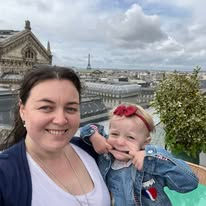
Both Natalie and I are responsible for genes which dictate that Bea’s hair is not growing as fast or as long as other children. I was next to bald until nearly two, and Natalie didn’t have all that much hair even when she went to primary school! This has given Bea a bit of a complex, as she has been mistaken for being a boy on more than one occasion. Nothing upsets her more. So she is very keen to wear dresses and to ensure that they are visible. Bea has been born into a world that has tried to break down strict gender demarcations, but she hasn’t read the script! She is quite clear that girls have long hair and like pink, and her little best friend in the village seems to think so too. I don’t know what they will call the post-2020 generation, but don’t blame us if they are all conservative (with a small ‘c’, hopefully)!
As parents, Natalie and I have attempted the delicate balancing act between being loving and encouraging whilst setting boundaries. This is not at all easy. I would not be confident that we have got everything right. Little children need a lot of help with sharing, timekeeping, cleanliness, and tidiness, for example. Well, yes, I hear you cry, a lot of adults do too! True, and in little children you can see the roots of all the sloppy behaviours that we lapse into later. But also much more positive ones, like loving others and showing it, enthusiasm, playfulness, and imagination. Bea can laugh as heartily as any adult and probably more so.

Bea has a great sense of humour, even if – along with her age group – she is somewhat fixated on wee and poo. It is interesting how many children’s books cash in on that interest. We have one which wonders ‘whatever happens to all that poo, that comes from the animals at the zoo’, and concludes that it ends up in food, particularly of the kind that children like: pizza toppings, birthday cake, ice cream, etc. And another tells the story of a fluffy toy bear who, like many small children, tries to delay going for a pee until things get super-desperate. He starts dancing and holding himself so his friends, a giraffe and a robot, drag him along to the loo. Bea is a great procrastinator when it comes to going to the toilet.
Parenting is certainly a potent mix of joys and cares! I am not sure whether Bea has been to A&E five or six times; I am losing count. And none of these were trivial, not even in retrospect. We would take her again in the same situation. A forceful bash of the head, a heartrate or temperature that goes off the scale, or projectile vomiting resulting in calls to 111 which have recommended a trip to the hospital. But none of those resulted in anything serious, I am extremely relieved to say. Young children are very prone to accidents and unpleasant infections; it is all part of learning, growing, and building up antibodies. The world is a challenging place. You probably know that, before the advent of modern medicine, quite a high proportion of children didn’t make it through. Although we now take it for granted that they will, this doesn’t dissuade a parent from a lot of worrying. At least the 4-year-old Bea seems to have fewer coughs and colds than the 2-year-old (although there is some evidence that she has inherited my summer allergic sniffle). And, consequently, she is sleeping much better, which means that so are we!

And the worries also concern non-life-threatening situations. Children cling to things that they should grow away from: dummies, nappies, breast-feeding, babyish books and TV programmes. Helping a child to move on is part of a parent’s job, but this has to be a gentle process and sometimes it takes much longer than the parent would prefer. When to force and when to leave alone, that’s a tough call. It’s good to get the thoughts of other parents as long as you don’t then become paranoid because your child is not up to the point where others have reached. Each child progresses in their own way, in some things faster than others. My parents used to say about me, ‘He could write his name at three and couldn’t tie his shoelaces at six.’ That is my life story in one short sentence. Bea is likewise reasonably advanced in terms of her use of language and less so at practical things. Having said that, she quite likes crafts and helping Mum with baking, so she might not end up being as poor as I was (and am) at practical activities.
We do everything we can to stimulate Bea and give her a chance to develop skills and keep active. So she goes to soft play centres and participates in various events and classes which include physical activities, or arts and crafts. All this costs a bit, but it is money well spent. My generation certainly never had anything like as much to do, and we didn’t go to any kind of school until we were five. And we didn’t have computers and smart TVs; my parents didn’t have any sort of TV until I was ten. How did we survive? Well, we managed but a child deprived of these things today would be out of step with the rest of her generation and slip behind. At least in the 1950s and 1960s we were all in the same boat. But some things are perennial and continue to be popular with children from generation to generation: fluffy toy animals, dressing up, colouring in, fairy stories, characters like Thomas the Tank Engine, Peter Pan, Winnie the Pooh, playing with toy cars, trains, and planes, dolls and prams for the girls. Maybe boys these days have dolls and prams too, but I haven’t got a boy, so I’m not sure whether they do!

Bea loves shows; we have taken her to Disney on Ice, where she told us to ‘shsh’ if we spoke during the performance. She has been to Opera North events for children and sits transfixed on the soprano’s warbling. Next, she is going with her friend to the ballet, which could prove expensive if she takes a liking to it! Music development is at an early stage but there is promise. Bea instinctively sings and hums while she plays. She knows classical tunes that she has heard on the cartoon Little Einsteins, which sets out to stimulate appreciation of art and music in small children. It’s odd to have a child humming Beethoven or Dvorak as she wanders through the shopping mall, but odd in a very nice way! She also enjoys the occasional plink on the piano that we have (because Natalie played as a child) and a peep on the recorder. Her cousin Richard bought her a guitar as a birthday present; she is certainly interested but not quite yet at the stage of concentration where we can sit her down and teach her a few basics on any of these instruments. It is just a matter of time; they sit there waiting for her. Please don’t remind me that Mozart was already composing at the age of four: who wants a daughter who is too much of a clever clogs?
I think that most children of Bea’s age suffer from a kind of attention deficit disorder. Bea certainly does. She gets out a scooter and cycling helmet, forgets them, and wanders off watering flowers. Games come out of the cupboard and get left all over the floor without being played with. Mealtimes are particularly tricky: each and every diversion drags Bea away from eating properly. She does not sit still at the table, and food goes cold. She prefers unhealthy to healthy food. Of course, you who are parents will know that all this is quite normal, but forgive me – it’s my first time, although I did have regular contact with my nephews and nieces when they went through this age and so it is not wholly unfamiliar.

When I get frustrated with all the mischief as inevitably all parents do, I do not for one second blame Bea herself. She will develop into a wonderful woman, I tell myself. This is just a childish phase that we all go through. Instead, I turn my frustration towards Nature itself. Why is it so difficult, I shout inwardly to the heavens! Nature does not make it easy. Why do children listen to and obey everyone apart from the very people who love them most and who will ensure that they are safe and happy? Why do they keep awake at night the very people who need to be on the ball to look after them the next day? Why do they like precarious balancing, acting like monkeys but without the dexterity of those animals? Why are their bad tempers so violent? Why do they eat anything apart from the foods that give them the most nourishment and best health prospects? Etc., etc. Nature hasn’t answered me yet. But I have learnt that bringing up children is a labour of love and that anything less than absolute love is not going to get you through.
Yet of course there are many wonderful moments which eclipse the difficult ones. Bea holding my hand as we walk through the streets; leaning her head on my shoulder during the bedtime story; sitting on my lap typing the alphabet on my laptop; lounging in the living room snuggled up next to me watching TV; getting me to lay down the tracks for her toy trains. We enjoy making up silly stories or singing together. We both have a somewhat crazy imagination, we like humming, and we have a fascination for the solar system. So it is not difficult to see that she is my daughter through and through, although she is not as introverted as I was at her age; she has a ready smile and is friendly with most people she meets. To sum it all up, she is my wonderful and beautiful daughter of whom I am very proud (as well as being a thorough pain in the neck; she scolds me every bit as much as my wife does!).

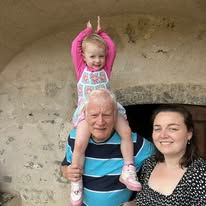
Bea likes riding on my shoulders, and she is getting heavier as I get older. It makes me think of my namesake, St Christopher, a legendary figure in the early Church. His name meant ‘carrier of Christ’. His legend describes how he was asked to carry a baby across a river by wading through. This seemed an easy task, but the baby got heavier and heavier, and he only just made it. The he found out that the baby was Jesus. The story is, of course, a metaphor for the Christian vocation. Carrying Jesus demands a supreme effort if followers are to live the life for which he is the pattern. In my case, the story strengthens my resolve when Bea is jumping about on my shoulders, trying to do the opposite of what is safe when you’re small and sitting at that height. St Christopher is the patron saint of travellers, but he got removed from the list of saints only recently when the Vatican accepted that he was just a metaphor and not an historical figure. So it’s up to us Christophers today to be saintly so that one of us takes the place in heaven that is now vacant! I think that being the father of Bea definitely qualifies me. And Natalie deserves to be a saint too, for looking after the both of us.



Lovely to read about your darling Bea and thrilled that she likes to announce her full name! Not just when she has been called it for being tiresome then!! Memories myself of trying to get away with shortening bedtime stories and getting pulled up by the small child who knew the story by heart! Much love to you all xxxx